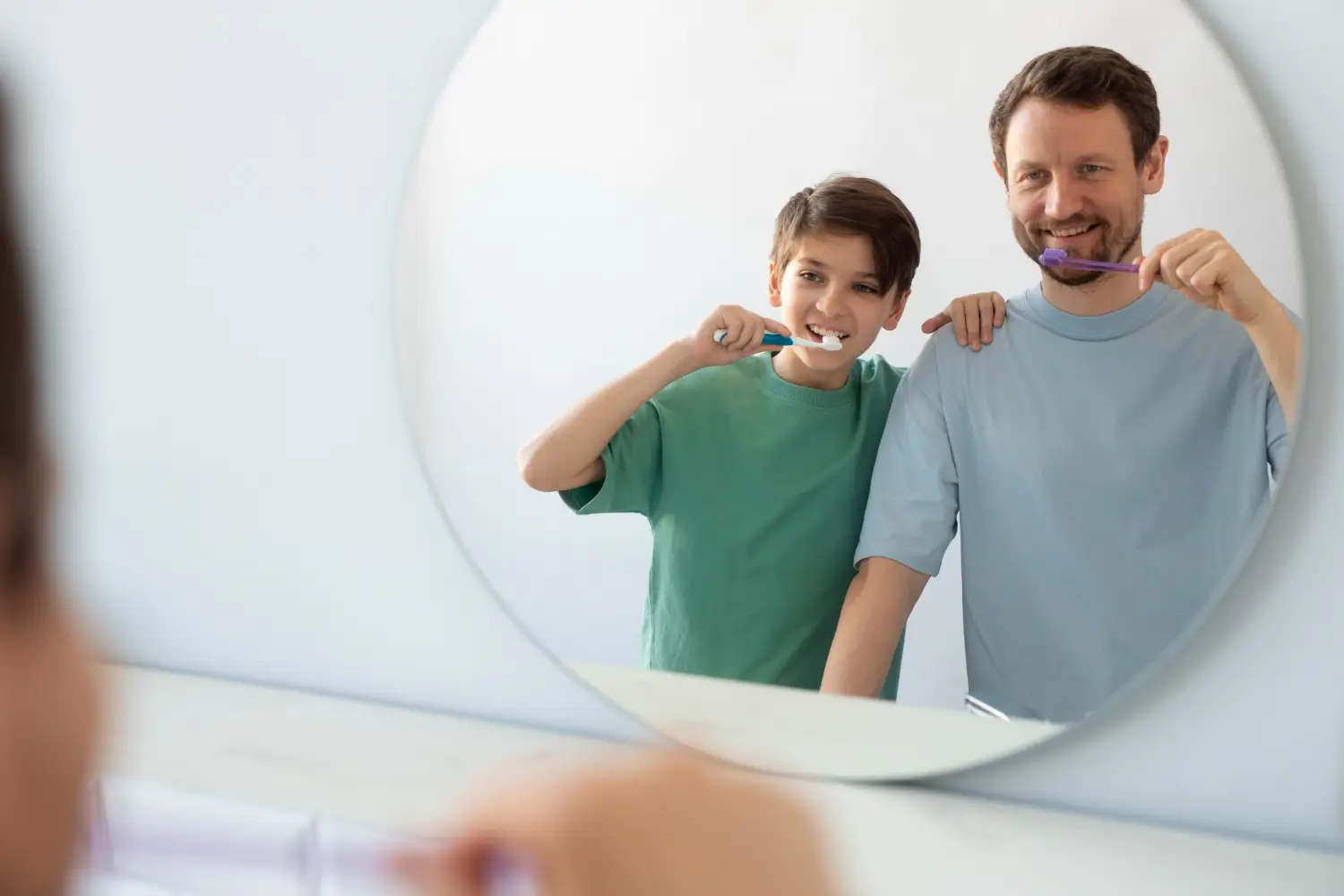
Sometimes additional treatments are required to maintain optimum oral health. At Bright Ridge Dental, our array of hygiene services includes:
Regardless of your needs, you can be assured that all of our hygiene services are performed by highly trained and experienced dental hygienists who are dedicated to supporting and preserving your continued oral health.
Q: “How can I maintain good dental hygiene at home?”
A: You don’t have a skilled hygienist to help you maintain your oral health on a daily basis, but by brushing for two minutes at least twice a day and flossing daily, your at-home oral hygiene routine can keep your teeth and gums healthy between your routine dental visits.
Q: “What services are performed at a scheduled cleaning?”
A: Services your hygienist will perform during your cleaning include:
Q: “How often should I visit the office to maintain good dental hygiene?”
A: Dr. K.C. and Dr. Kait recommend that you schedule two routine visits each year in order to prevent decay and maintain optimal oral health.
For more information about the hygiene services we offer, please call our Bentonville dental office at (479) 715-4277 and make your appointment today!
Informational Video from Mouth Healthy/ADA on sealants:
Are you doing everything you can to make sure your children brush every day and eat healthy but they still get cavities? Fortunately, at Bright Ridge Dental— your local Bentonville family dentists — Drs. K.C. and Kaitlin Dietz can include sealants in your child’s dental plan: a noninvasive, preventive tooth-decay treatment that protects teeth and keeps them healthy while they mature and strengthen. Dental sealants are made from a resin material that is used to coat the chewing surfaces of the back teeth. It is painted on and seals the nooks and crannies in the teeth so that food and other cavity-causing materials are kept out.
At Bright Ridge Dental, the procedure for applying sealants is simple, painless, fast, and takes only one visit. First Dr. K.C. and Dr. Kaitin will remove debris from your teeth and thoroughly clean and dry them. Next the sealant material is painted on the chewing surface. It will naturally bond to the tooth on its own; however, a special light may be used to speed the process, helping the sealant to harden in just a couple of seconds.
Q: “Are sealants only for children?”
A: Though dentists most often use dental sealants as a protective tooth-decay treatment for children, they are also perfect for adults who don’t have cavities or fillings in their molars. Talk to Dr. K.C. and Dr. Kait about protecting your teeth by adding them.
Q: “How long do dental sealants last?”
A: Dental sealants are incredibly strong and can withstand the force of chewing. They have been found to reduce the rate of decay by over 70%, and they can last over a decade.
Q: “Do I still need to brush and floss twice a day with sealants?”
A: Sealants only protect the chewing surfaces of the back teeth from cavities. Brushing and flossing regularly is the only way to make sure all of your teeth, as well as your overall oral health, stay in excellent condition.
Q: “Does your sealant material contain bisphenol-A (BPA)?”
A: No, we use a product called Ultraseal XT from Ultradent Products of Jordan, UT. Per the manufacturer’s website, “…Bisphenol-A (BPA) is a potentially harmful chemical used in some plastic materials including bottles, cans, home electronics, and even tooth sealants. However, Ultradent has always been aware of the risk associated with BPA and has never used it in UltraSeal XT plus or UltraSeal XT® hydro. We’ve even hired a third-party laboratory to test our sealants, and they confirmed they have a 0.00000% rate of BPA.” More info at: https://www.ultradent.com/en-us/Dental-Products-Supplies/Prevent-Hygiene/Pit-and-Fissure-Sealants/UltraSeal-XT-plus/Pages/default.aspx
The team at Bright Ridge Dental’s Bentonville dental office is happy to answer your questions about sealants and cavity prevention. Call (479) 715–4277 to find out more or to set up an appointment.
According to the Centers for Disease Control and Prevention, tooth decay is one of the most prevalent and preventable chronic disease in children and adults today. More than 90% of adults aged 20–64 have experienced tooth decay and tooth decay is one of the most common diseases of childhood—5 times as common as asthma, and 7 times as common as hay fever. Tooth decay is typically symptomless until there’s already a cavity or a tooth abscess (an infection at the root of a tooth or in the gums), both of which can lead to pain and tooth loss if left untreated. That’s why at Bright Ridge Dental we make prevention of tooth decay your dental plan’s primary focus.
Tooth decay occurs when the mouth’s naturally occurring, harmful bacteria combine with the sugars from food, producing acids. Over time, the acids eat away at your tooth’s enamel, causing tooth decay and eventually cavities or dental caries. Symptoms of tooth decay or a tooth abscess include:
If you have a diet high in sugars and carbohydrates, drink from a water source that does not contain fluoride, or suffer from reduced salivary flow, you may be at risk for tooth decay. Young children are at higher risk for decay than are adults.
Successful preventive care requires good oral hygiene practices at home and routine visits to the dentist. At Bright Ridge Dental, our Bentonville dentists Drs. K.C. and Kaitlin Dietz understand that finding a dentist you have confidence in is key to maintaining a healthy smile, so we put extra effort and time into forming a long-term, trust-based relationship with all of our patients.
The following are steps you can take at home and during your routine dental visits to prevent tooth decay and improve your overall oral health:
If you have been diagnosed with tooth decay, the best course of treatment will depend on its severity. The following treatments are used once decay has eaten through tooth enamel:
Q: “What is a tooth abscess?”
A: A tooth abscess is an infection that occurs at the root of a tooth or between the tooth and gum as a result of severe tooth-decay trauma. Signs that you may have a tooth abscess include fever, tooth pain/sensitivity, bad breath, swollen glands, swelling in the gums or upper or lower jaw, and open sores.
Q: “Is tooth pain a sign of tooth decay?”
A: Tooth pain can be a sign of tooth decay or other oral health issues. If you are experiencing tooth pain, you should contact our dentist and have it diagnosed immediately.
Q: “Is tooth extraction necessary if you have tooth decay?”
A: Tooth extraction may become necessary in severe cases of tooth decay. Extraction will only be considered after every possible avenue that preserves the tooth is exhausted.
Call (479) 715-4277 to find out more about tooth decay and prevention or to schedule your routine exam with our Bentonville dental office today.
What Our Office Uses – The Latest Technology
Other Non-digital Offices – Old Technology
Our hand-held NOMAD’s high-frequency, 60kv DC x-ray generator provides constant radiation output. This improves image quality while reducing the dose to the patient relative to traditional half-wave (AC) generators. This amounts to 63% less radiation to the patient!
Comparison to medical imaging*:
Lower GI series 4.060 mSV
Upper GI series 2.440 mSV
Chest x-ray 0.080 mSV
*The information above is from the American Dental Association website
Cosmic radiation exposure:
Flying one round trip Seattle – Chicago 0.02-0.039 mSV
Max allowable exposure for US airline crews 11.0 mSv
Average radiation exposure for flight crews 2.19 mSv
Annual background radiation exposure:
Average radiation per person from outer-space in Denver, CO: 0.510 mSV
Average radiation from natural sources per person in the US:3.000 mSV